
Dear Nandan: The NEET Crisis Was Never a Leak Problem. It Is a Design Problem
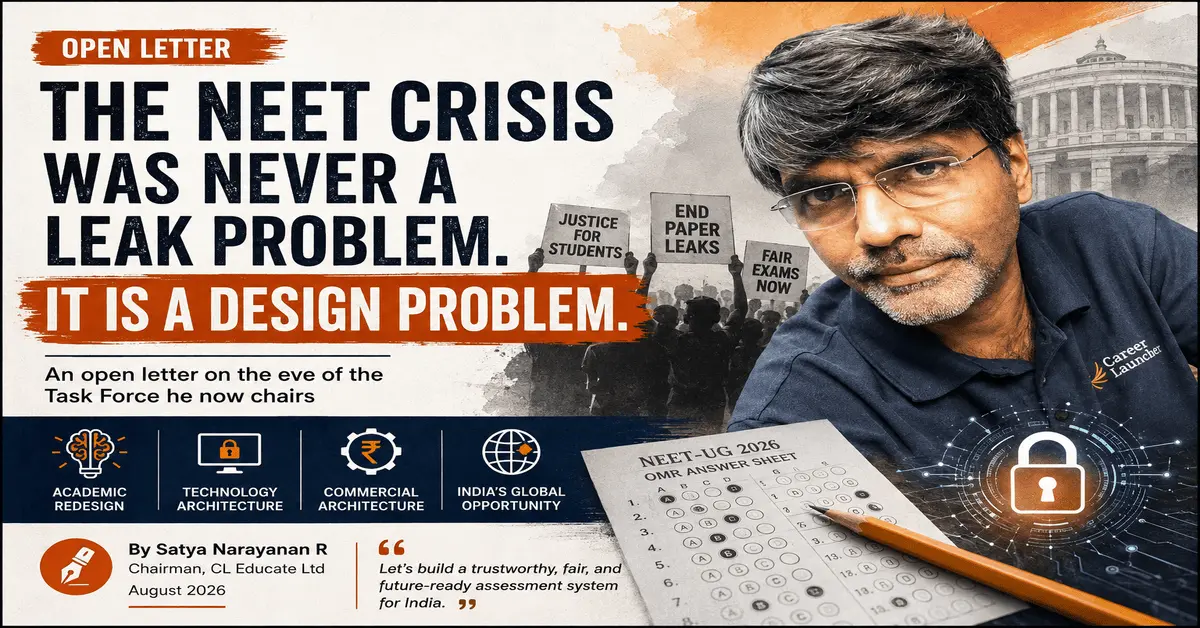
An open letter to Nandan Nilekani, on the eve of the Task Force he now chairs
By Satya Narayanan R, Chairman, CL Educate Ltd | August 2026
Dear Nandan,
You have built two things India will be studied for: a national identity layer that 1.4 billion people now trust with their fingerprints, and a national payments rail that moved a nation of cash-hoarders into digits overnight. Both succeeded not because they were clever technology, but because they were the right architecture solving the right problem. Prime Minister Modi has now handed you a harder brief. Aadhaar had to prove who you are. UPI had to prove a transaction happened. Your task force has to prove that a mark on a certificate means something – after a summer in which the country discovered, in the most painful way possible, that it often does not.
I write to you not as a bystander but as someone who has spent three decades inside India’s assessment and learning industry, watching this crisis build in slow motion long before it became urgent. I run a listed company that lives and dies by the credibility of Indian examinations. I have a stake in your success that is both national and personal. So take this letter in the spirit it is meant: as an operator’s brief, not an op-ed writer’s applause.
Why we are here
The NEET-UG 2026 leak, the cancelled exam, the re-test for over two million anxious candidates, the dozen-plus young lives lost to suicide, the hunger strike at Jantar Mantar, the tear gas on Parliament Street, and finally Dharmendra Pradhan’s resignation – none of this was a single administrative failure. It was the visible eruption of a fault line that has been widening for fifty years.
Two generations ago, a child’s academic performance was the family’s private concern. Schools, boards and government carried none of the load, and that arrangement – however imperfect – kept assessment honest, because nobody upstream had an incentive to inflate it. Somewhere in the last twenty years, the Gross Enrolment Ratio and pass-percentage statistics became a government obsession. And the moment a statistic becomes a political target, someone finds a way to hit it. Boards, colleges and coaching factories that were unethical quietly began match-fixing the outcome: everybody gets 90 percent, and real-world skill has almost nothing to do with it.
Three decades ago, you could score 50 percent in your Class XII boards and still crack an IIT, because the JEE tested conceptual and abstract ability that had little to do with rote memorisation – the Irodov-and-Halliday kid who was ordinary in school could still out-think everyone else on entry day. That door has quietly closed. JEE Mains has become, in effect, an extension of the Class XII board exam. IIM admissions now weight your Class X marks, your Class XII marks, your undergraduate marks, even your gender, on top of CAT. The unconventional, brilliant, non-normal student – the non-maggu who doesn’t fit the mould – no longer finds a seat in India’s premier institutions. School itself has become an inconvenience to be routed around through dummy schools. That is only the symptom. The disease is the exam architecture upstream of it, and it is that architecture your task force must now rewrite.
Part One: the academic redesign
Principle One – reduce the multiplicity of exams while increasing the multiplicity of opportunity. India does not lack exams; it drowns in them, and yet a bright student still has fewer real doors than she should. Take the American SAT as the model, not because it is foreign but because it is simple: one base exam feeding many destinations. India has already proven this works – JEE Mains folded nearly every engineering entrance into one gateway, while JEE Advanced was rightly preserved as a harder, separate filter for the IITs. Extend that logic. Combine the base entrance for engineering, BBA, hotel management, IPM, architecture, design and the like into one instrument that tests critical thinking, creativity, communication and collaboration – the four competencies that matter regardless of stream – and let 1,500 universities and 60,000 colleges plug into it. Once built, this is an exportable standard. Much of the Global South is still assembling what India could hand them ready-made.
Principle Two – an exit exam and an entrance assessment are not the same instrument, and must stop pretending to be. Board marks can inform undergraduate admission at the margins, but they should not be load-bearing. CUET, as it stands, tests 28 subjects at a level too shallow to discriminate between candidates – an exam that cannot tell the top student from the middling one is not an exam, it is a formality with a fee attached.
Principle Three – design for a test that coaching cannot brute-force. The single biggest driver of educational inequity in India today is not poverty of talent, it is unequal access to coaching. The fix is not to ban coaching – that battle is lost – but to stop testing what coaching is good at manufacturing: rote, repetition, and access to superior material. Strip out the memory-heavy General Knowledge sections that carry disproportionate weight in UPSC and CLAT, and replace them with reasoning, critical thinking, creativity and communication – skills a three-month cram course cannot fake.
Principle Four – accept that a good board score does not predict cognitive ability, and build the system around that truth rather than in denial of it. Stop testing bookish knowledge as a proxy for aptitude. Start detecting diverse skills and inclinations as early as Class VIII, with a formal, dignified pathway into vocational tracks – not a fallback for those who “couldn’t make it,” but a genuine parallel route. Delink subject marks and syllabus content entirely from entrance weightage for jobs and higher education. And honour the spirit of NEP 2020 by building a real off-ramp after Class X or XII into work, with a guaranteed, friction-free path back into formal education whenever the student is ready. A system that only allows one direction of travel – study, exam, more study – is a system that punishes anyone whose life doesn’t move in a straight line, which is to say, almost everyone.
Part Two: the technology architecture
This is the part of the brief where your own history is most directly useful. Build toward an on-demand computer-based test, with the normalisation science already proven in multi-shift, multi-cohort exams like UGC-NET and CAT, handling the statistical work of comparing students who never sat in the same room. Set a three-year horizon to move from that baseline CBT to a genuinely adaptive instrument – section-adaptive in the manner of the GRE, or item-adaptive in the manner of newer domestic platforms. And treat remote proctoring not as a vendor feature but as national assessment infrastructure, deserving the same strategic, Atmanirbhar Bharat-style investment that India has given to space and defence technology. You, more than almost anyone alive, know that Aadhaar and UPI succeeded because India was willing to treat trust infrastructure as a sovereign capability rather than outsource it. Remote, leak-resistant, low-stake examination delivery deserves exactly that posture – it is what will let India retire the logistics and cost burden of shipping paper and human proctors to every corner of the country for every low-stakes test.
Part Three: the commercial architecture nobody wants to say out loud
Somebody has to say the quiet part: examination fees in India are a significant revenue stream for incumbents, typically ranging from ₹1,500 to ₹3,000 per candidate, against an actual cost of conducting the exam of roughly ₹150 to ₹300. That gap is not illegitimate on its face – but it has not been reinvested nearly aggressively enough in the security, infrastructure and leak-proofing that this crisis has shown to be non-negotiable. Your task force should use its leverage to redirect that economics: give assessment partners – public and private – real elbow room and real accountability to invest in tamper-proof processes, and price integrity as a cost of doing business, not an afterthought funded out of margin.
Why this crisis is also India’s opening
Nandan, it would be easy to read this summer only as tragedy – the leak, the deaths, the resignation, the tear gas on Parliament Street. It was all of that, and none of it should be minimised. But look one layer further out. More than 150 countries are still building the assessment infrastructure India already half-has: national-scale digital identity, national-scale digital payments, and now – if your task force gets this right – national-scale trustworthy assessment. They are 30 to 50 years behind India on process, know-how and market readiness. India can build this, prove it at a domestic scale no other country attempts, and export it exactly as it exported Aadhaar’s architecture and UPI’s rails. In fact, assessments is an ideal candidate to be put as the third leg of the DPI trilogy. But, that’s for another day, I guess.
With roughly one in four of the world’s working-age population expected to be Indian in the coming decades, a credible, technology-native, coaching-resistant assessment system is not just a fix for this summer’s crisis. It is the foundational layer for India’s transnational education and workforce export story for the next thirty years.
You have a formidable task force, and a country watching to see whether this becomes India’s next Aadhaar moment or its next missed opportunity. I hope this letter, and three decades in the trenches of Indian assessment, are of some use to you and your colleagues as you get to work.
With respect and in service of India’s next generation,
Satya Narayanan R
Chairman, CL Educate Ltd